
"Why is my tax bill so high? I barely took anything out of the practice."
I hear some version of that every October or November. The answer can be a number of things.
- Business profit is up and your tax withholding hasn't increased.
- You used up all your deductions last year so this year's taxes are likely more than last year.
- You accelerated debt payoff and do not have a cash cushion for the upcoming tax payment.
Timing is a critical factor in the size your tax bill each April.
Why It Matters
A good year is supposed to feel good. Instead, a lot of owners find out in April that they owe $100,000 they didn't set aside, plus a penalty for underpaying along the way.
The money usually went somewhere in the business to bonuses, equipment, debt, or inventory. Now you need to draw cash from a line of credit or from selling investments at a time you didn't choose.
The fix is cheaper if you catch it in the fall. It gets expensive in April.
Cash Out Is Not the Same as Income
For most practice and firm owners, the business is a pass-through. The profit lands on your personal return whether or not you moved it to your personal account.
The IRS taxes what the practice earned, not what you transferred. A distribution is just a transfer of money that was already taxed as profit. Leaving cash in the business account doesn't shelter it from taxes, and pulling cash out doesn't create a second tax.
I talk about this all the time with owners and this is the mix-up behind most surprise bills.
Profit went up by $200,000. Owner pay and estimated payments stayed the same. The gap shows up on April 15. There is a better way to handle this.
The Two Ways to Pay In During the Year
The IRS wants its money as you earn it, not in one lump the following spring. You have two tools for that.
| Tool | How it works | Good to know |
|---|---|---|
| Withholding | Tax taken out of your W-2 salary before you see it | The IRS treats it as paid evenly through the year, no matter when it came out |
| Estimated payments | Four separate payments you send in yourself | Credited on the date paid. Late or light payments pick up a penalty |
That first "good to know" is the useful one. If you discover a shortfall in November, a bump in salary withholding for the last few paychecks counts as if you'd been paying it all year. A late estimated payment doesn't get that treatment.
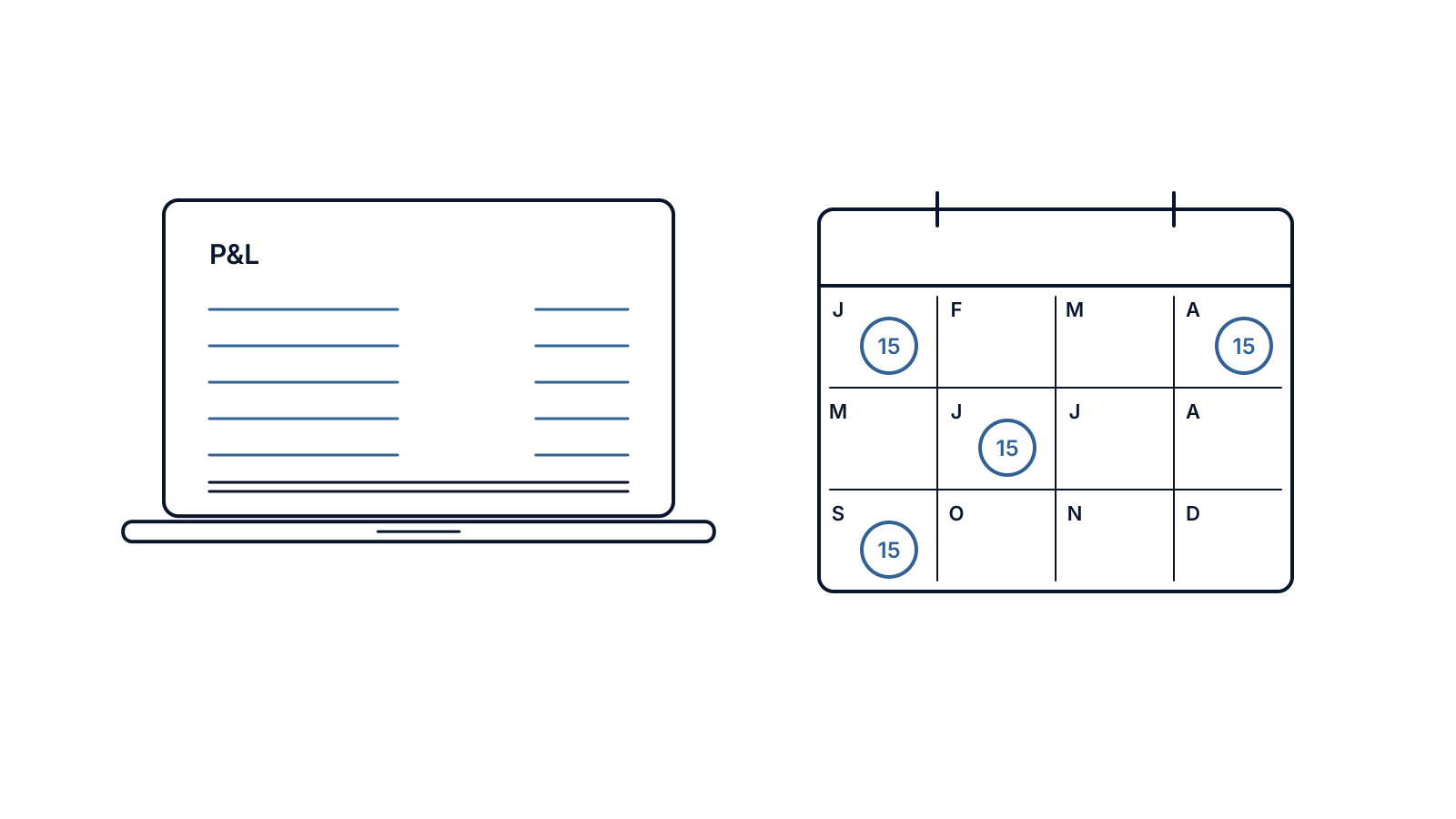
To avoid the underpayment penalty for 2026, you generally need to pay in at least 90% of this year's tax, or 100% of last year's tax (110% if your 2025 adjusted gross income was over $150,000). The 2026 due dates for estimated payments are April 15, June 15 and September 15, 2026, and January 15, 2027.
How We Like to Handle It
I prefer building a tax forecast or projection in October or November over a surprise in April.
The process is short:
- Pull profit through the latest closed month. Not the bank balance. The P&L.
- Estimate the rest of the year. Remaining collections, payroll, any equipment purchases.
- Add up what's already been paid in. Withholding plus estimates to date.
- Compare the projected tax to the safe harbor. That tells you whether a penalty is in play.
- Fix it with withholding first. Adjust the last few paychecks, then set aside cash for whatever's left.
Owners with irregular distributions, spousal income, or a side gig need this more than W-2 employees do.
A Worked Example (Illustrative Only)
A Dallas practice owner runs her practice as an S corporation. In 2025 her total federal tax was $110,000. In 2026 she added a hygienist and raised fees, and profit is tracking $140,000 higher.
Here's where she stands in October:
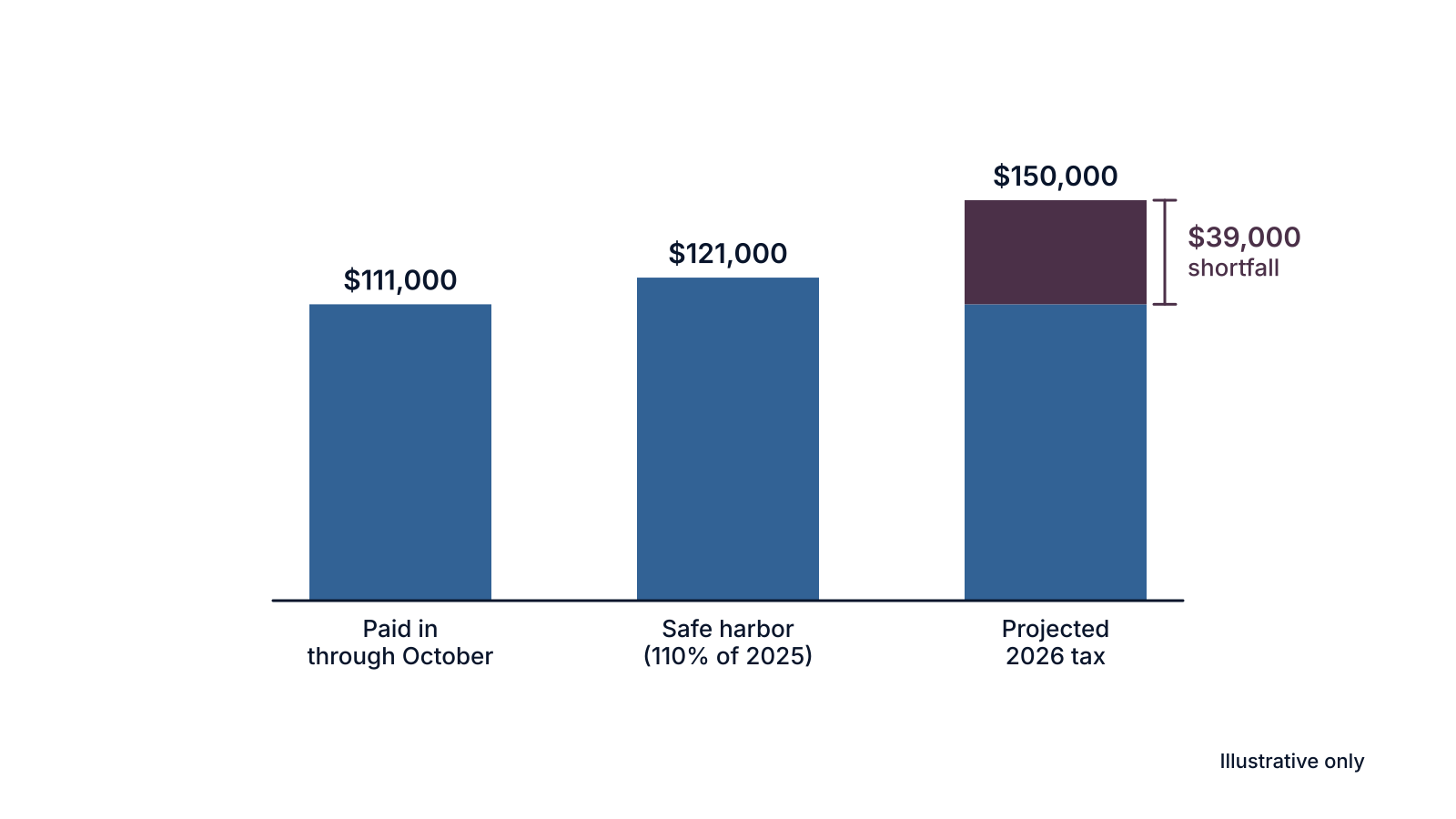
- Projected 2026 tax: $150,000
- Withholding on her $200,000 salary: $55,000
- Four estimated payments, still set at the 2025 amount: $56,000
- Paid in so far: $111,000
- Shortfall: $39,000
Her safe harbor is 110% of 2025, or $121,000, because her income is over $150,000. She's $10,000 short of it, so a penalty is in play on top of the balance due.
The fix:
- Raise withholding on her last 5 paychecks by $2,000 each. That's $10,000, treated as paid all year, and the penalty exposure goes away.
- Move $29,000 into a “tax reserve” savings account at a bank now, so the April balance is covered.
Avoid a cash scramble by planning ahead and setting aside cash now.
What Else to Review Before Year-End
A projection also shows you what's still worth doing before December 31.
- Retirement contributions. For 2026, the 401(k) employee deferral limit is $24,500, plus an $8,000 catch-up at 50 or older, or $11,250 at ages 60 through 63. Total contributions to a defined contribution plan are capped at $72,000 before catch-ups, on compensation up to $360,000. A SEP IRA shares the $72,000 cap. A SIMPLE IRA allows $17,000, plus a $4,000 catch-up, or $5,250 at 60 through 63.
- Owner salary. If profit jumped, a reasonable S corporation salary may need to move too.
- Benefits. Health insurance for a 2%-or-more S corporation owner runs through payroll. Make sure it's reported right.
- Purchases. Buy the equipment because the practice needs it, not to create a deduction. Spending $1 to save $0.35 is still spending $0.65.
Our 12-month tax planning calendar lays out when each of these comes up.
A Few Watch-Outs
- The business account is not your checking account. Unlabeled transfers make the projection unreliable. Keep good books!
- Overpaying has a cost too. Sending the IRS an extra $40,000 in June is an interest-free loan to them, and the practice might have needed it for payroll.
- Income still unclear? Run a base case, a high case and a low case. Reserve for the middle one, and revisit in December or January.
- Partnerships are different. Partners pay self-employment tax on their share and don't have salary withholding to lean on, so estimates carry the load.
As always, the details matter. Coordinate with your CPA or advisor before you change withholding or skip a payment.
The Takeaway
A high tax bill after a good year is a timing problem. Profit moved and the payments didn't. Project it in the fall, fix it with withholding or estimated payments, and reserve the rest.
Think of the projection as a hygiene visit. The point isn't the cleaning. It's finding the small problem in October, when it's cheap to fix.
If you'd like a projection before year-end, see our tax planning services and book an intro call.
Written by Kyle Simmons, CFP®, a financial planner and shareholder at J.E. Simmons and Company. J.E. Simmons and Company is a fee-only registered investment adviser serving business owners from Dallas, Texas. This article is general information, not tax or investment advice for any specific situation. Tax rules change and apply differently depending on facts. Figures cited are for the 2026 tax year. Please consult a qualified financial planner or tax professional before acting.
Disclosure
The content and information presented herein are for educational purposes only and should not be construed as a solicitation or offer to buy or sell any investment services. Nothing contained in this material should be considered an offer to provide any product or service in any jurisdiction that would be unlawful under the securities laws of that jurisdiction. The information contained herein has been obtained from sources believed to be reliable; however, the Firm does not guarantee accuracy or completeness of the information. Such information is subject to change at any time without notice. Before taking any action, you should consult with a qualified tax, legal, or financial professional.
This article is for informational purposes only and is not individualised investment, tax, or legal advice. See our disclaimer.