
Financial Planning
Tax Planning
Taxes


Saving for college is a major financial decision, and the accounts you choose can affect taxes, financial aid, and how much you ultimately save. Here is a brief overview of the different types of account parents can use to save for college.
For most families, 529 plans form the foundation of college savings because they combine tax efficiency, flexibility, and favorable treatment in financial aid formulas.
Key benefits
In practice, 529 plans allow families to dedicate money to education while still preserving flexibility if circumstances change. The Roth IRA rollover provision has reduced the risk of overfunding and created a path for unused education savings to support long-term retirement goals.
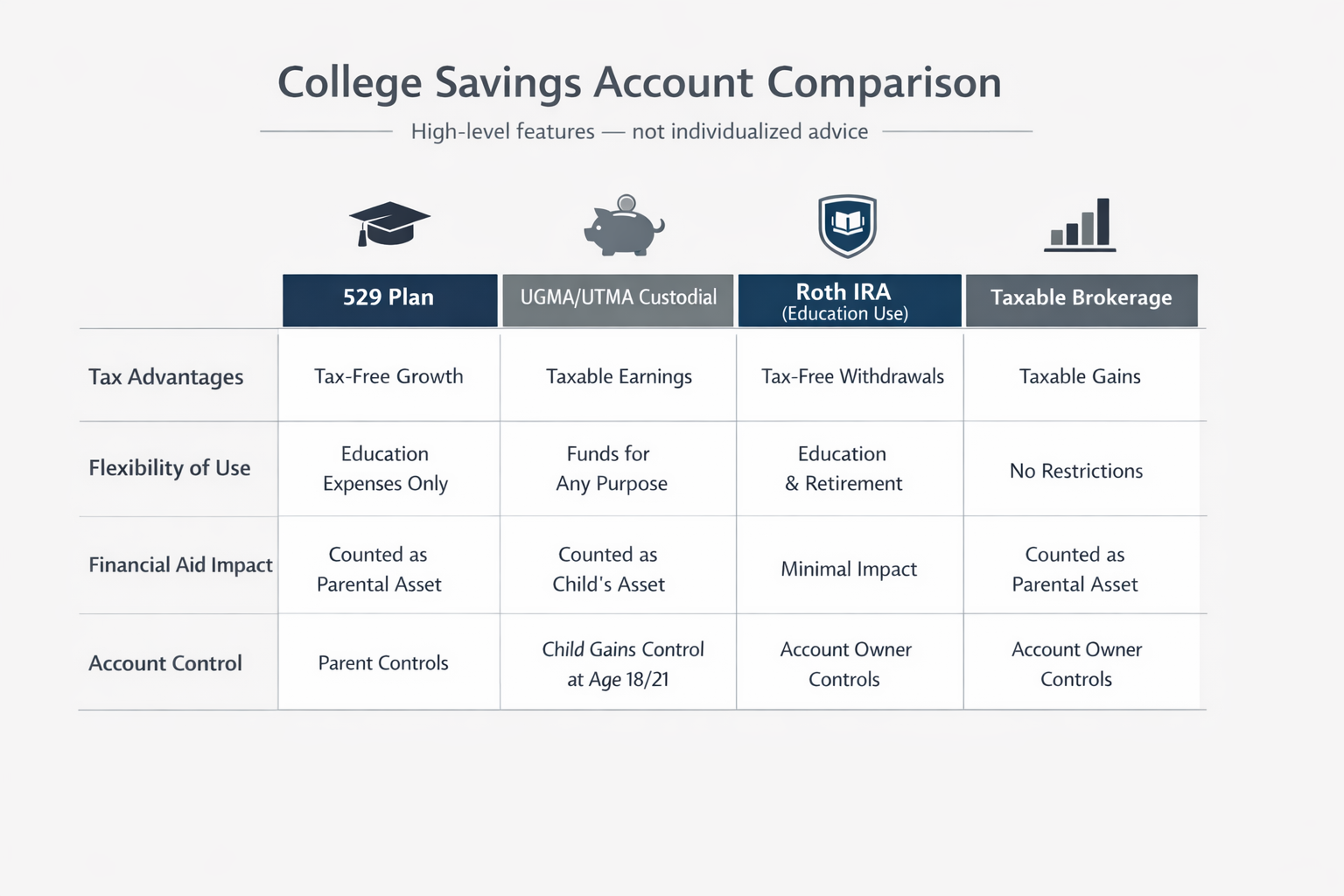
From a financial aid perspective, parent-owned 529 plans are treated favorably compared to taxable brokerage accounts and student-owned assets.
UGMA and UTMA accounts are custodial investment accounts where assets legally belong to the child. A parent or other adult manages the account until the child reaches the age of termination, typically age 18 or 21 depending on state law.
Primary advantages
That flexibility comes with important trade-offs. Contributions are irrevocable gifts, and once the child reaches the age of termination (18 or 21 depending on state laws), they gain full control of the assets. These accounts can also create tax friction under the kiddie tax rules and are heavily penalized in financial aid calculations.
Because UGMA and UTMA assets are treated as student-owned, 20 percent of the account value is counted toward college costs each year. This can significantly reduce aid eligibility, though it may be less relevant for families with high incomes who do not expect to qualify for need-based aid.
Roth IRAs are designed for retirement, but limited exceptions allow them to be used to help fund education.
Potential benefits
Despite these advantages, Roth IRAs are rarely an ideal primary education funding vehicle. Annual contribution limits restrict how much can be accumulated, and withdrawals are reported as income on future FAFSA applications, which can reduce financial aid eligibility.
For business owners, employing children in the business can create an opportunity to fund a Roth IRA with earned income. Any funds not ultimately used for education can continue to grow tax-free and support long-term retirement planning.
Brokerage accounts offer maximum flexibility but fewer tax advantages.
Key strengths
While investment income is taxable, brokerage accounts can be useful when families want flexibility or anticipate that funds may be used for non-education goals.
There is no single best way to save for college. The most effective strategies balance tax efficiency, financial aid considerations, flexibility, and retirement security. For many families, this means combining multiple account types and coordinating education funding with broader financial and tax planning.
If you would like to discuss how we help our clients save for education expenses, please book an introduction below.
Disclosure
The content and information presented herein are for educational purposes only and should not be construed as a solicitation or offer to buy or sell any investment services. Nothing contained in this material should be considered an offer to provide any product or service in any jurisdiction that would be unlawful under the securities laws of that jurisdiction. The information contained herein has been obtained from sources believed to be reliable; however, the Firm does not guarantee accuracy or completeness of the information. Such information is subject to change at any time without notice. Before taking any action, you should consult with a qualified tax, legal, or financial professional.